


















































ISLAMABAD (MNN); Pakistan on Thursday firmly rejected remarks by Tulsi Gabbard, who had suggested that the country’s evolving missile capabilities could pose a potential threat to the United States.
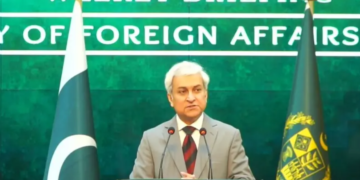
In a statement, Foreign Office spokesperson Tahir Hussain Andrabi said Pakistan “categorically rejects” the assertion made by the US official, calling it unfounded and inconsistent with strategic realities.
The response came after Gabbard, while briefing lawmakers, included Pakistan among countries that could potentially threaten the US homeland through advanced missile systems. She had warned that Islamabad’s missile development might eventually extend to intercontinental ranges.
The Foreign Office emphasised that Pakistan’s strategic and missile capabilities are strictly defensive and are designed to ensure national sovereignty and maintain regional stability.
“Pakistan’s missile programme remains well below intercontinental range and is guided by the doctrine of credible minimum deterrence vis-à-vis India,” Andrabi stated.
He contrasted this with India’s missile advancements, noting that New Delhi’s development of systems with ranges exceeding 12,000 kilometres raises broader regional and global concerns.
The spokesperson reaffirmed Pakistan’s commitment to maintaining constructive relations with the United States, stressing the importance of mutual respect, factual accuracy, and non-discriminatory engagement.
“We urge a more balanced and responsible approach that contributes to peace, security, and stability in South Asia,” he added.
Earlier, former caretaker foreign minister Jalil Abbas Jilani also dismissed Gabbard’s claims, stating that the idea of Pakistan’s missiles reaching the US homeland “is not grounded in strategic reality.”
In a post on X, Jilani reiterated that Pakistan’s nuclear doctrine is India-centric and focused on deterrence within the region rather than global power projection.
During her testimony before the US Senate Intelligence Committee, Gabbard said that countries including Russia, China, North Korea, Iran, and Pakistan are developing advanced missile systems capable of carrying nuclear and conventional payloads.
She warned that Pakistan’s long-range ballistic missile programme could potentially evolve to include intercontinental ballistic missiles (ICBMs) capable of reaching the United States.
Gabbard also noted that these countries are closely monitoring US missile defence strategies to shape their own capabilities and assess American deterrence policies.
According to the US intelligence assessment, missile threats to the American homeland are expected to increase significantly, with projections suggesting a rise from over 3,000 missiles today to more than 16,000 by 2035.
Analysts say Pakistan’s inclusion in such threat assessments reflects a continuation of earlier US policy trends. In December 2024, similar concerns were raised by a senior White House official regarding Pakistan’s potential development of long-range missile capabilities.
During the same period, the United States imposed additional sanctions on entities linked to Pakistan’s ballistic missile programme, alleging their involvement in the development and delivery of such systems.