








SPORTS DESK (MNN); Iran’s newly appointed Supreme Leader Ayatollah Mojtaba Khamenei has been injured but remains safe, according to the son of President Masoud Pezeshkian, offering the first official explanation for the leader’s absence from public view since his appointment.
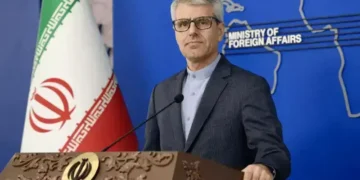
Yousef Pezeshkian, who also serves as a government adviser, said on Wednesday that he had received confirmation about Mojtaba Khamenei’s condition after reports circulated about possible injuries.
In a message shared on his Telegram channel, Yousef Pezeshkian said he had heard reports suggesting that Mojtaba Khamenei had been wounded. He added that after contacting individuals who had access to reliable information, he was informed that the Iranian leader was “safe and sound”.
The statement marked the first public clarification regarding the health and whereabouts of the 56-year-old cleric since he assumed Iran’s top leadership position over the weekend.
Mojtaba Khamenei, who previously maintained a relatively low public profile despite wielding significant influence behind the scenes, was appointed as Iran’s Supreme Leader following the assassination of his father, Ayatollah Ali Khamenei.
The elder Khamenei was reportedly killed in an air strike during the early stages of the ongoing US-Israeli war against Iran that began on February 28.
The attack, which targeted a compound in Tehran, is believed to have also claimed the lives of Mojtaba Khamenei’s mother and wife, according to several reports.
Following his father’s death, the Assembly of Experts — the powerful clerical body responsible for appointing the country’s supreme leader — swiftly named Mojtaba Khamenei as the new leader of the Islamic Republic.
However, since his appointment, the new supreme leader has not appeared in public or delivered any official address, leading to growing speculation about his physical condition and whereabouts.
Iranian state television earlier referred to Mojtaba Khamenei as a “wounded veteran of the Ramazan war” but did not provide further details regarding his injuries.
According to a report by The New York Times, citing three unnamed Iranian officials, Mojtaba Khamenei sustained injuries during the conflict, including wounds to his legs. Despite the injuries, he is said to remain conscious and alert while staying at a highly secure location with restricted communication.
Analysts believe he may have been injured during the daytime air strike on the Tehran compound that killed several members of his family on the first day of the war.
Although he has not appeared publicly, his image has begun appearing across the Iranian capital.
Large billboards in Tehran display Mojtaba Khamenei symbolically receiving the national flag from his father while the founding leader of the Islamic Republic, Ayatollah Ruhollah Khomeini, looks on.
Posters featuring his portrait were also seen during a large pro-government rally held in central Tehran on Monday, where thousands of supporters gathered to demonstrate loyalty to the new leadership.
Mojtaba Khamenei’s father, Ayatollah Ali Khamenei, had himself survived an assassination attempt in 1981, an attack widely blamed on the opposition group known as the People’s Mujahedin of Iran.
The blast left the elder Khamenei with a partially paralysed arm for the remainder of his life.
Security experts believe Mojtaba Khamenei may remain out of public view for some time due to the heightened threat environment.
Emile Hokayem, an analyst at the London-based International Institute for Strategic Studies, suggested that the new Iranian leader would likely remain in a heavily protected location.
He said the situation surrounding the deaths of his family members during the initial air strike had dramatically increased the risks to his personal safety.
According to Hokayem, Israel may prioritise targeting the new leader in the early stages of the conflict. However, he added that if Mojtaba Khamenei survives the ongoing war, he could become a powerful symbol of the resilience of Iran’s political system.
Hokayem also suggested that the new supreme leader might delegate key responsibilities within the government.
He predicted that national security chief Ali Larijani could play a major role in managing the country’s governance while parliamentary speaker Mohammad Bagher Ghalibaf might oversee the war effort.
Following his appointment, Iran’s armed forces and the powerful Islamic Revolutionary Guard Corps pledged allegiance to Mojtaba Khamenei.
Support for the new Iranian leader has also come from allied groups in the region, including Yemen’s Houthi rebels and Lebanon’s Hezbollah movement.
International reactions have also emerged in response to the leadership change.
Russian President Vladimir Putin has reportedly promised Iran “unwavering support” during the ongoing conflict.
Meanwhile, US President Donald Trump had earlier warned that Mojtaba Khamenei would not be acceptable as Iran’s new supreme leader.
Speaking to ABC News, Trump said the new leader would have to gain approval from Washington if he wanted to remain in power, adding that without such approval he would not last long.