

















































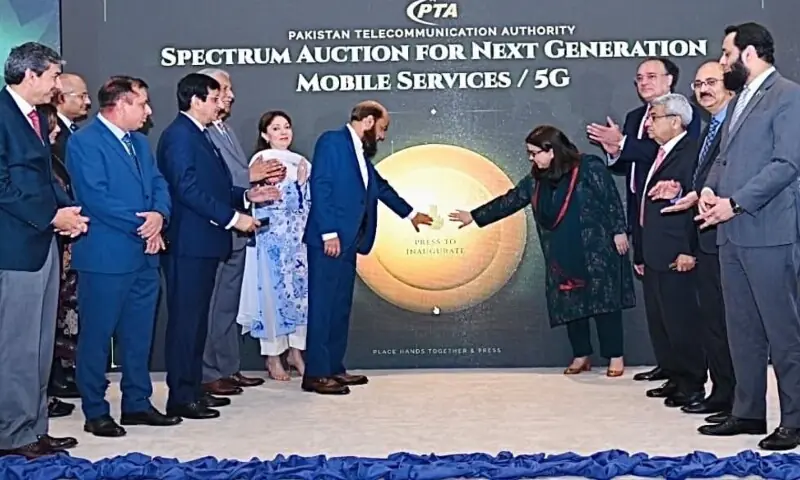
ISLAMABAD (MNN); The government successfully concluded Pakistan’s 5G spectrum auction in Islamabad on Tuesday, selling 480 megahertz of spectrum for $507 million after the third round of bidding.
Three telecom operators — Zong, Jazz and Ufone — competed for the crucial 2600 MHz frequency band required for launching 5G services. In the final outcome, Jazz secured 190 MHz of spectrum, Ufone acquired 180 MHz and Zong obtained 110 MHz.
The government had set base prices for various spectrum bands including $32.5 million for 700 MHz, $16.8 million for 1800 MHz, $70 million for 2100 MHz, $10 million for 2300 MHz, $12.5 million for 2600 MHz and $6.5 million per lot for the 3500 MHz band.
The auction process was held in the presence of Finance Minister Muhammad Aurangzeb, Information Minister Attaullah Tarrar, former IT minister Syed Aminul Haque, and the chairperson and members of the National Assembly Standing Committee on Information Technology and Telecommunications.
Under the auction rules, each telecom company was required to purchase at least 100 MHz of spectrum. Jazz emerged as the largest buyer, acquiring spectrum not only in 5G-compatible bands but also in frequencies used for long-distance telecommunications.
Jazz purchased 20 MHz in the 700 MHz band, 50 MHz in the 2300 MHz band, 70 MHz in the 2600 MHz band and 50 MHz in the 3500 MHz band. Ufone acquired 60 MHz in the 2600 MHz band and 120 MHz in the 3500 MHz band, while Zong secured 60 MHz in the 2600 MHz band and 50 MHz in the 3500 MHz band.
Following the announcement of results, Jazz Chief Executive Officer Amir Ibrahim said the company had purchased the 700 MHz spectrum to expand services in rural and less populated areas.
He also announced that 5G test trials would begin for Jazz customers from Wednesday at 180 towers across the country.
During the auction process, the Pakistan Telecommunication Authority initially offered 190 MHz in lots of 10 MHz each. However, bidders demanded 30 lots, prompting the regulator to make an additional 110 MHz available for auction. The PTA also increased the bid price of the 2600 MHz band by five percent over the base price.
For the 3500 MHz band, which is also considered important for 5G services, 28 lots of 10 MHz were offered, but telecom companies placed bids for only 20 lots. Breaks were taken before the second and third rounds of bidding.
Addressing the ceremony, Finance Minister Muhammad Aurangzeb thanked the members of the spectrum committee and credited the IT ministry for maintaining policy continuity that enabled the auction despite changes in government.
He said digital technology was not an end in itself but a tool to improve services and opportunities. According to him, faster, cheaper and better digital connectivity would support job creation and help the private sector drive economic growth.
The minister added that emerging technologies such as artificial intelligence, blockchain and Web 3.0 would benefit significantly from the availability of additional spectrum and the rollout of 5G services.
Aurangzeb also linked the move to the government’s austerity measures announced by Prime Minister Shehbaz Sharif, saying improved connectivity would facilitate online education and remote working during times of crisis.
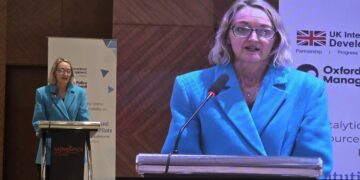
Information Technology Minister Shaza Fatima Khawaja described the spectrum auction as one of the most important milestones in Pakistan’s digital history. She noted that Pakistan had first entered the 3G and 4G era during the government of former prime minister Nawaz Sharif, but no major spectrum auction had taken place since then, leading to connectivity challenges.
She said the new auction would not only introduce 5G services in Pakistan but also significantly improve the quality of 4G connectivity across the country.
The minister highlighted that internet connectivity had become essential for all sectors including the economy, agriculture, industry and national security.
Comparing Pakistan with Bangladesh, she said the neighboring country, despite having a smaller population, had around 600 MHz of spectrum available compared to Pakistan’s 274 MHz.
She noted that Pakistan had been operating on the same spectrum since 1997, but the successful auction would double the country’s available spectrum.
Shaza said the public would start seeing noticeable improvements in 4G services within four to five months, while 5G services are expected to be introduced in five major cities within the next five to six months.
The IT minister also acknowledged the contributions of former IT minister Syed Aminul Haque for laying the groundwork for the spectrum auction and praised Prime Minister Shehbaz Sharif’s vision for a “Digital Nation Pakistan.”
She added that the government was also working on other key initiatives including satellite-based internet services for remote areas, connecting Pakistan with international cable systems to become an internet transit hub, and expanding the country’s fibre optic network.
To support these efforts, the government has abolished right-of-way charges for fibre infrastructure, becoming the first country in Asia to take such a step. This move, she said, would help improve connectivity and reduce internet costs in the long term.
Telecom companies have long maintained that spectrum is an invisible but essential infrastructure that drives digital connectivity and supports modern economic and social systems.