














































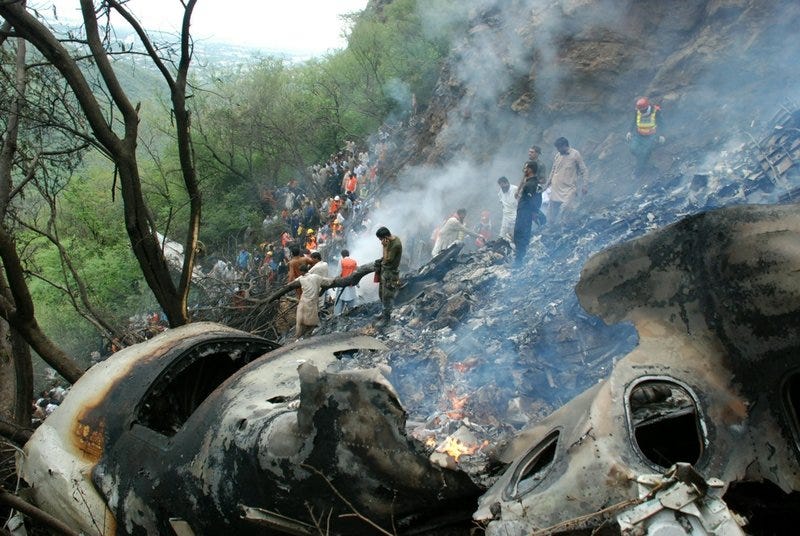
ISLAMABAD (MNN); An additional district and sessions court in Islamabad has ordered Airblue to pay Rs5.4 billion in compensation to the families of eight victims of the 2010 Airblue plane crash in the Margalla Hills.
The court also dismissed an appeal filed by the airline and imposed a Rs1 million fine on Airblue for causing undue delays in the case.
The verdict was announced by Judge Rasool Bashir Mirjat, who upheld Airblue’s liability for the crash that claimed the lives of all 152 passengers and crew members aboard Flight 202 on July 28, 2010. The aircraft was en route from Karachi to Islamabad when it crashed into the Margalla Hills.
According to the investigation report issued by the Pakistan Civil Aviation Authority, the accident was categorised as a Controlled Flight into Terrain. The report concluded that the flight crew failed to exercise sound judgment and professional competence while attempting to land in adverse weather conditions.
Serious violations of standard operating procedures and breaches of flying discipline were identified, which placed the aircraft in an unsafe position over hazardous terrain at low altitude.
The inquiry pointed to pilot error, including descent below the minimum safe altitude and deviation from approved procedures during a circling approach in poor visibility. Investigators also cited weak cockpit resource management and unfavourable weather, such as heavy rain and low cloud cover.
Later court observations and reports further noted that lapses by air traffic control also contributed to the unsafe circumstances preceding the crash.
The ruling is being seen as a major milestone in a legal battle that has continued for more than 15 years. Families of the victims had repeatedly demanded accountability, stating that prolonged litigation added to their grief and hardship.
Legal experts believe the judgment may serve as an important precedent for future aviation liability and compensation cases in Pakistan.
Court records show that most families were compelled by Airblue to sign release documents and accept first-tier liability payments as full and final compensation. However, a small number of families rejected the settlement, pursued legal action on the principle of fair compensation, and ultimately succeeded in securing enhanced damages through the court.