
































LAHORE (MNN); PML-N president and former prime minister Nawaz Sharif on Wednesday demanded accountability for the elements he alleged were responsible for bringing PTI founder Imran Khan to power, claiming that these actors were greater culprits than Imran himself.
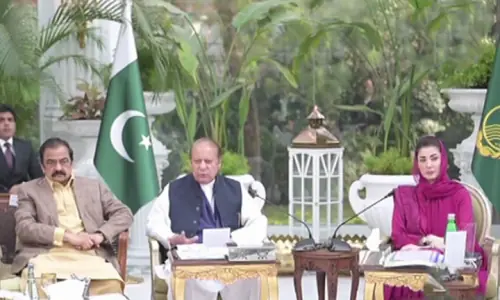
Addressing newly elected party lawmakers, Nawaz asserted that the responsibility should not fall on the former premier alone. According to him, those who supported and enabled Imran’s rise held an even larger share in the wrongdoing and must also face full accountability.
The PML-N leader, who has kept a relatively low public profile since his party joined the coalition government with the PPP in 2024, revisited the political events surrounding the 2018 elections. He referred to the allegations of electoral irregularities raised by PML-N at the time, including millions of rejected votes and discarded ballot papers found in several locations.
He accused PTI of branding opponents as thieves and looters while allegedly being more culpable themselves. Nawaz said the public now better understands what he called the previous government’s pattern of turmoil, confrontation and character assassination.
The former premier claimed that the years leading up to 2018 were marked by economic progress, lower inflation and strong growth. He lamented the decline in the currency’s value since 1999, stating that the fall from an 11-rupee Saudi riyal rate under Musharraf to around 78 today had made survival difficult for ordinary citizens.
Nawaz said the country was now heavily dependent on the IMF, limiting Pakistan’s sovereignty in economic decision-making. He argued that consistent growth could have prevented this situation.
He maintained that public support in the 2024 elections was a result of PML-N’s performance record, and praised both Prime Minister Shehbaz Sharif and Punjab Chief Minister Maryam Nawaz for working to stabilise the economy, avert default and revive development.
He cited ongoing provincial initiatives such as low-cost housing, hospitals, student scholarships, laptops, clean environment programs and green transport as signs of recovery, adding that improved security and welfare programs in Punjab were reaching people of all communities without discrimination.