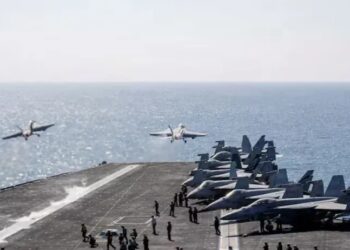




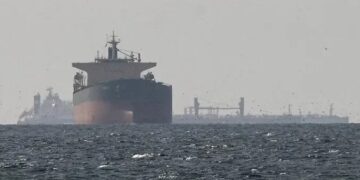


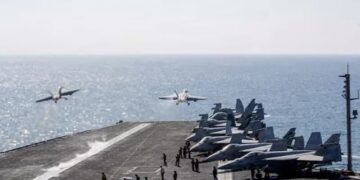























WASHINGTON (MNN); US President Donald Trump has announced the deployment of a second aircraft carrier to the Middle East as Washington steps up pressure on Iran over its nuclear and ballistic missile programmes.
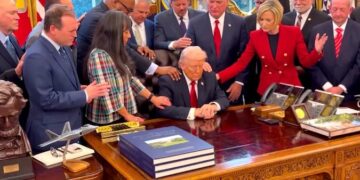
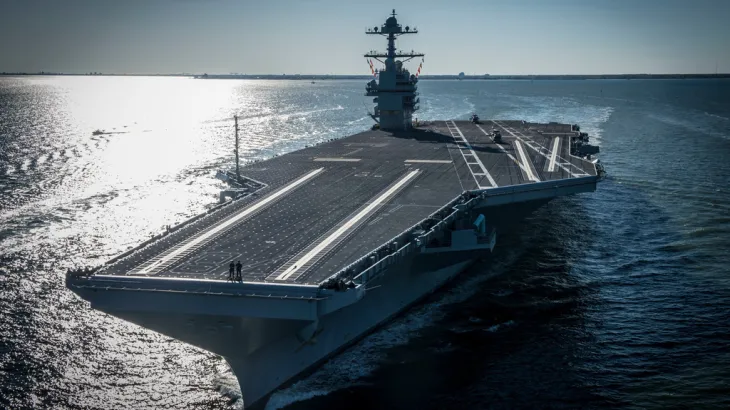
Speaking at the White House on Friday, Trump confirmed that the USS Gerald R Ford would soon depart from the Caribbean for the region, as tensions persist following indirect US-Iran talks held in Oman last week.
“If we need it, we’ll have it ready — a very big force,” Trump said, expressing optimism that negotiations could succeed but cautioning that failure to reach a deal would spell a “bad day for Iran.” He later remarked that a change of government in Iran would be the “best thing that could happen.”
The USS Gerald R Ford’s deployment forms part of a broader military buildup that already includes the USS Abraham Lincoln, multiple guided-missile destroyers, fighter aircraft and surveillance planes positioned in recent weeks.
Trump’s remarks came shortly after his meeting with Israeli Prime Minister Benjamin Netanyahu in Washington. Netanyahu expressed hope for a “good deal” but insisted that any agreement must also address Iran’s ballistic missile programme — a demand Tehran has rejected.
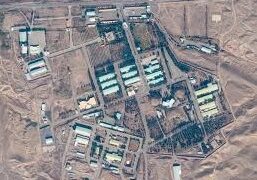
Netanyahu has continued to advocate further military action following Israel’s 12-day war with Iran in June, during which the United States briefly joined by striking three Iranian nuclear sites in an operation dubbed “Midnight Hammer.” Trump had claimed at the time that the strikes had “totally obliterated” Iran’s nuclear facilities.
The recent indirect talks marked the first engagement between Washington and Tehran since the June conflict disrupted negotiations over a possible successor to the Joint Comprehensive Plan of Action (JCPOA). The JCPOA, agreed between Iran, the US and several European nations, required Tehran to limit its nuclear activities in exchange for sanctions relief. Trump withdrew the US from the accord in 2018 during his first term.
Since then, Iran has expanded uranium enrichment beyond the deal’s limits, though it maintains that its nuclear programme is for peaceful purposes and denies seeking nuclear weapons.
Following his return to office in January for a second term, Trump initially pursued a fresh nuclear agreement but later adopted a strict zero-enrichment stance — a condition Iranian officials have dismissed as unacceptable.
Meanwhile, Rafael Grossi, head of the International Atomic Energy Agency, has faced challenges in securing access to inspect sites targeted during the June conflict. Addressing the Munich Security Conference, Grossi said inspectors had returned to Iran after the war but had not yet been granted access to the affected locations. He described dialogue with Tehran as “imperfect and complicated,” yet ongoing.
Gulf Arab states have warned that any further military escalation could ignite another regional conflict, particularly as the Middle East continues to grapple with the fallout from Israel’s war on Gaza.