












































Washington: Pakistan has vowed not to allow the desertification of its fertile plains, after India used the UN platform to threaten the continued suspension of the Indus Waters Treaty (IWT).
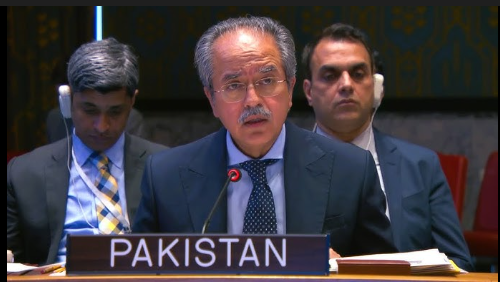
At a high-level open debate in the UN Security Council on Monday evening, Pakistan’s UN Ambassador Asim Iftikhar Ahmad described India’s unilateral suspension of the Indus Waters Treaty as “another blatant breach of international obligations, threatening the lives and livelihoods of millions and endangering peace and security”.
He informed the world body that “Pakistan rejects the weaponisation of water and other natural resources. Treaty compliance is a cornerstone of the international legal order”.
Later, Pakistan also used its right of reply to respond to the allegations and claims of the Indian ambassador, Parvathaneni Harish.
“By unilaterally and illegally suspending the Indus Waters Treaty, India now seeks to bring about the desertification of Pakistan’s ancient fertile plains,” Pakistan’s representative Zulfiqar Ali said, responding to India’s threat.
“We will counter this latest provocation this water terrorism with the same resolve, clarity, and success with which we defended our country against India’s aggression in May last year,” he added.
At the UN Security Council debate, Ambassador Harish reiterated New Delhi’s position that “the treaty will be held in abeyance until Pakistan credibly and irrevocably ends its alleged support for cross-border and all other forms of terrorism”.
Despite multiple independent assessments backing Pakistan’s position, the Indian ambassador also challenged narratives from Washington and Islamabad portraying Pakistan as the victor in the May 10 conflict.
Ambassador Ahmad addressed this issue, recalling that last May, India “carried out an unprovoked military aggression in breach of international law and Pakistan’s sovereignty”.
“Acting in accordance with Article 51 of the (UN) Charter, Pakistan exercised its inherent right of self-defence in a responsible, restrained and proportionate manner,” the Pakistani envoy added. “Our response established that there can be no ‘new normal’ based on coercion or impunity. Respect for international law remains the only legitimate norm governing inter-State conduct.”
The May 10 conflict also underscored that “the root cause of instability in South Asia remains India’s illegal occupation of Jammu and Kashmir, in gross violation of Security Council resolutions,” Ambassador Ahmad said.
Pakistani representative Zulfiqar Ali reminded the Indian envoy that Pakistan not only prevailed in the previous conflict but remains fully capable of thwarting any future attempts.
In his right of reply, Mr Ali described India’s statements as “spurious claims” and part of an “old ploy” to deflect attention from its illegal occupation of Jammu and Kashmir.
“India’s sermons on law, justice and fairness ring hollow from a country that spreads falsehoods, orchestrates global assassination campaign, and plots terrorism regionally and beyond,” he said, highlighting India’s politicisation of even innocuous fields like sports.
Mr Ali also criticised India’s internal policies, saying the country exemplifies “how tyranny of majoritarianism can disrupt the social fabric of a political entity”.
He pointed to state-sanctioned pogroms against Muslims, Christians, Sikhs and other minorities, noting that sham claims of being the world’s largest democracy could not conceal these atrocities.