















































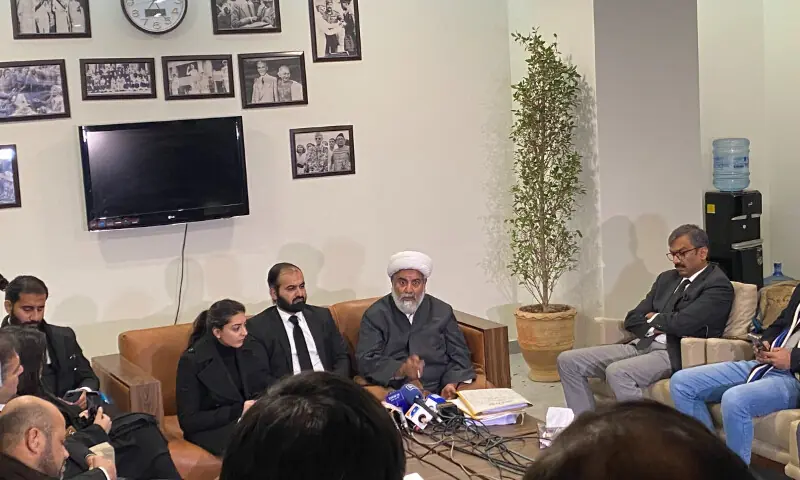
ISLAMABAD (MNN): Shortly after being notified as the opposition leader in the Senate on Tuesday, Majlis Wahdat-i-Muslimeen chief Allama Raja Nasir Abbas met lawyers Imaan Zainab Mazari-Hazir and Hadi Ali Chattha, expressing solidarity with them and lamenting that dissent had been turned into a crime in Pakistan.
The meeting was held at the office of the Islamabad High Court Bar Association president. A statement shared on Abbas’s X account later outlined his remarks to the media following the interaction.
Abbas said Pakistan was passing through a “severe crisis”, adding that fundamental rights, constitutional guarantees and human dignity were being continuously violated.
He said civil society, lawyers, human rights organisations and all voices raising questions were under pressure, while dissent was being criminalised. According to him, those who speak up face imprisonment, cases and violence, despite the Constitution guaranteeing people the right to choose their rulers.
The Senate opposition leader said the country was engulfed in political, economic and social turmoil, adding that people often approached courts for justice but were left disappointed.
Referring to Balochistan, Abbas said the wounds of its people were still fresh, but instead of dialogue and political wisdom, force and operations were repeatedly chosen. He questioned what issues had been resolved after decades of such operations and warned that widespread injustice leads to national disintegration.
He urged the rulers to show restraint and not further damage Pakistan’s international standing, warning that the consequences of repression could not be contained. Abbas said millions of Pakistanis were unable to afford two meals a day and questioned whether raising such concerns should be met with bullets, batons and criminal cases.
Calling Imaan Mazari and Hadi Chattha voices of the oppressed, he said silencing young people who speak against injustice would only strengthen their message. He criticised the registration of an FIR against Mazari after six months, alleging it was aimed at incarcerating her at any cost, and said such actions damaged the dignity of the judiciary.
Abbas warned that suppressing voices through imprisonment only amplifies them and advised the authorities to refrain from oppressive measures, saying the country could no longer bear further strain.
He also criticised what he termed a wider crisis of justice, warning that proceedings against Imaan and Hadi would further erode public trust in the judiciary. He stressed that accountability should not become revenge and reiterated that the Constitution guarantees life, liberty and freedom of expression.
Meanwhile, a case registered against Imaan Mazari and Hadi Chattha in July 2025 in connection with a protest by the Baloch Yakjehti Council resurfaced on Tuesday. The couple filed pre-arrest bail pleas, which could not be taken up urgently as they sought to avoid arrest.
IHCBA President Syed Wajid Ali Gilani later escorted them to his office and assured them complete safety, saying no arrest would take place within the bar premises. A large contingent of police remained outside.
Separately, the Islamabad High Court on Tuesday restored the bail of Imaan and Hadi in a controversial social media posts case after a sessions court had cancelled it on January 15.
The case, registered under the Prevention of Electronic Crimes Act, accuses them of inciting linguistic divisions and portraying the armed forces as engaging in terrorism. On January 17, the couple challenged their arrest orders in the IHC, arguing their right to defence had been unlawfully curtailed.
During the hearing, the IHC judge reinstated their bail, suspended the arrest warrants and restored their right to defence, directing that cross-examination be completed within three days.
Earlier,
The Islamabad High Court (IHC) on Tuesday restored the bail of lawyer and activist Imaan Mazari-Hazir and her husband, Hadi Ali Chattha, in a case concerning controversial social media posts, after a sessions court had cancelled their bail on January 15.
The case has been registered under the Prevention of Electronic Crimes Act (PECA), 2016, with the accused facing allegations of promoting linguistic divisions through social media content and portraying the armed forces as being involved in terrorism within the country.
On January 17, Mazari and Chattha approached the IHC to challenge the arrest orders, contending that the trial court had unlawfully restricted their right to defence, issued arrest warrants without meeting mandatory legal requirements, and ordered their judicial custody along with virtual production.
During Tuesday’s hearing, the IHC judge reinstated their earlier bail and suspended the arrest warrants issued by Additional District and Sessions Judge Muhammad Afzal Majoka. The court also ordered the accused to complete cross-examination within three days and restored their right to defence.
At this point, their counsel, Kamran Murtaza, requested additional time from the court. “I will look into it. You should proceed with the trial,” the judge remarked.
Proceedings on Monday
A day earlier, Justice Azam Khan of the IHC, who is hearing the matter, had granted Mazari and Chattha one-day protective bail and directed them to appear before the court on Tuesday.
During Monday’s hearing, Murtaza informed the court that his clients’ bail had been cancelled on two occasions. “Now an order has been issued to arrest them,” he said.
He further argued that “if there were any misdoings on his client’s part, the judge should demonstrate patience”.
“The judge is holding hearings every 15 minutes,” he said.
Earlier the same day, Judge Majoka had expressed concern over the failure to arrest the accused and directed officials of the National Cyber Crime Investigation Agency to obtain search warrants for their residence from a magistrate. He also ordered that Mazari and Chattha be produced before the court by 11am.
However, following the IHC’s intervention, the proceedings were adjourned to January 20. Judge Majoka directed that the accused be presented in the sessions court “within one hour of their appearance at IHC”.
However, after the IHC’s orders, the hearing was adjourned to January 20 (today).
Judge Majoka directed that the accused should be presented in the sessions court “within one hour of their appearance at IHC”.
UPDATED