















































ISLAMABAD: India has accelerated the construction of large-scale hydropower projects on the Chenab River, a move Pakistan has described as the deliberate “weaponisation of water,” further straining relations between the two nuclear-armed neighbours and escalating disputes under the Indus Waters Treaty (IWT) of 1960, according to media reports.
According to officials, New Delhi is rapidly expanding dam construction in the disputed region of Jammu and Kashmir while manipulating river flows, raising serious concerns over Pakistan’s water security.
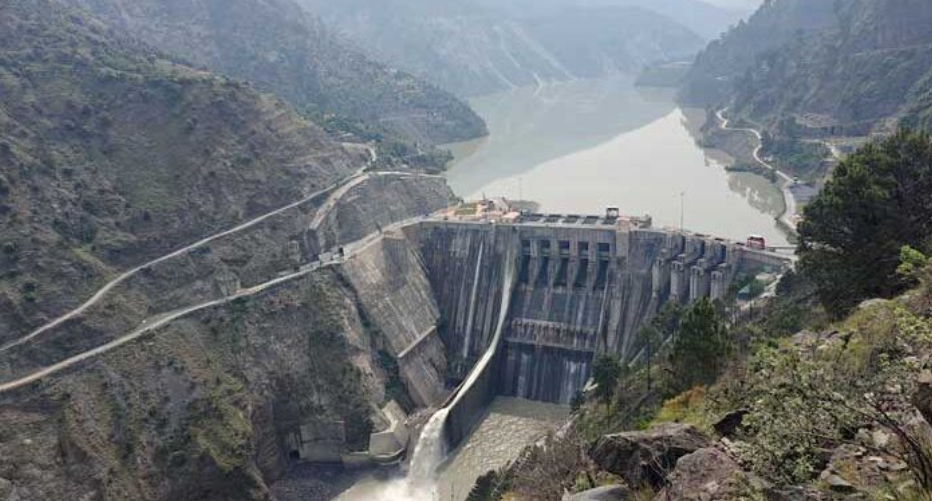
At the centre of India’s latest push is the 1,856-megawatt Sawalkote Hydropower Project, which received environmental clearance in October 2025. Located in the Ramban district, the run-of-the-river project will feature a 192.5-metre-high dam and an underground powerhouse expected to generate nearly 8,000 million units of electricity annually. The project will be developed in two phases. Stage I includes six 225MW units and one 56MW unit, while Stage II will add two additional 225MW units. Spanning 1,401 hectares, including 847 hectares of forest land, the project is also expected to displace local communities.
Although Sawalkote was initially approved in 2017, its execution gained momentum in 2025 following India’s controversial announcement to place the Indus Waters Treaty in abeyance a move Pakistan has rejected as illegal and provocative. Analysts warn that Sawalkote, along with several other mega-projects, reflects India’s broader strategy to tighten control over rivers allocated to Pakistan under the treaty. India has also approved the 260MW Dulhasti Stage-II project in Kishtwar district, adding further pressure on Chenab flows. Existing operational projects on the river include Dulhasti-I (390MW), Baglihar I & II (890MW), and Salal (690MW), while Ratle (850MW), Kiru (624MW), and Kwar (540MW) are currently under construction.
Additional projects such as Bursar, Pakal Dul, and Kirthai I & II are either in planning stages or being fast-tracked. Pakistan has also said India is deliberately manipulating water flows during the current winter season. Officials say India released 58,000 cusecs of water at Head Marala on December 7–8, 2025, before drastically reducing flows to 870–1,000 cusecs between December 13 and 17. Historically, Chenab flows during this period range from 4,000 to 10,000 cusecs. Islamabad maintains that India violated the IWT by repeatedly emptying and refilling the Baglihar reservoir, an action the Court of Arbitration ruled on August 8, 2025 as constituting “weaponisation of water.”
Pakistan’s Commissioner for Indus Waters, Syed Mehr Ali Shah, confirmed that Islamabad has formally notified India, presenting scientific evidence of deliberate flow manipulation and invoking Articles VI and VIII of the treaty to demand immediate consultations.The current standoff traces back to April 23, 2024, when India unilaterally announced it was holding the IWT in abeyance.
Pakistan’s National Security Committee, chaired by Prime Minister Shehbaz Sharif, rejected the move outright, warning that any attempt to block or divert Pakistan’s water would be treated as an act of war.With mega-dam construction, altered river flows, and diplomatic tensions on the rise, the Chenab River has emerged as a new flashpoint in one of South Asia’s most critical water disputes, raising fears of serious environmental, agricultural, and geopolitical consequences in the months ahead.