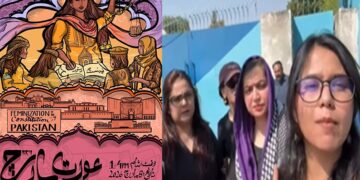






































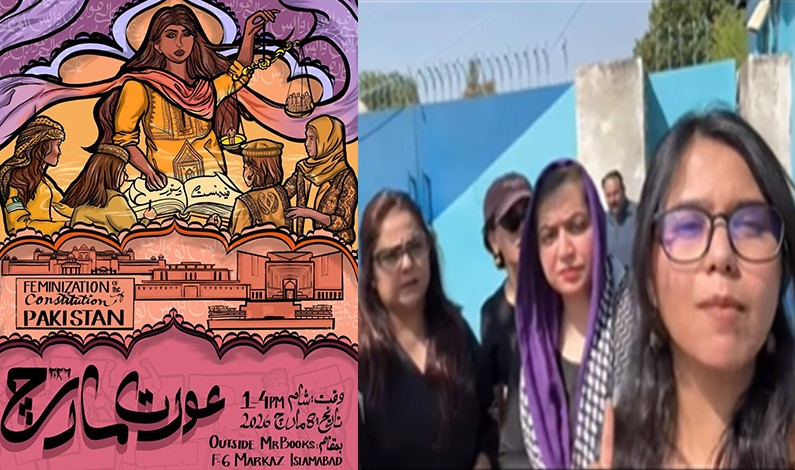
ISLAMABAD (MNN); Police detained several women’s rights activists, including members of Aurat March, in Islamabad on Sunday as they attempted to organise a rally to mark International Women’s Day.
According to police sources, the activists were taken into custody near Super Market in Sector F-6 when they tried to move towards the National Press Club, where they planned to gather for the march. A large police presence had already been deployed in the area, and the participants were stopped and transported to the Women’s Police Station.
Authorities confirmed that 19 women associated with Aurat March were among those detained. The list included prominent women’s rights activist Dr Farzana Bari, her two daughters, and noted human rights advocate Tahira Abdullah, along with several organisers and participants of the march.
Police officials said that, in addition to women activists, a number of male participants were also detained during the operation.
One of the participants, Zoya Rehman, said on social media platform X that her husband and around 20 other men had been taken into custody by police. She added that there was no clear information about when those detained would be released.
Police sources said the detentions were made because Section 144 of the Criminal Procedure Code remained in force in the federal capital. The provision allows authorities to prohibit gatherings of four or more people for a specified period in order to maintain public order.
Civil society activist Tariq Mehmood Ghouri told Dawn that more than 25 people, including both men and women, had been detained based on information available so far.
He added that the wife of the Human Rights Commission of Pakistan Secretary General Haris Khaliq, along with several other women who went to the Women’s Police Station to meet the detained activists, had also been held inside the premises.
“They have been told to remain in another lockup and are not being allowed to leave,” Ghouri said.
Responding to questions about the planned rally, Ghouri said the marchers had gathered near Super Market and did not intend to move towards D-Chowk. He also alleged that police used force while dispersing the protesters.
Meanwhile, Aurat March Islamabad shared a video on its official Instagram account showing Dr Farzana Bari and several other women seated inside what appeared to be a police vehicle after their detention.
Police officials maintained that the district administration had denied a no-objection certificate (NOC) for the Aurat March, making the gathering an unlawful activity.
They also said that the administration was concerned about possible tensions, as the management of Lal Masjid had reportedly vowed to prevent the march from taking place. Officials claimed the arrests were made to avoid a potential law and order situation.
The arrests were strongly criticised by participants and supporters of the march, who said detaining women activists on International Women’s Day was deeply regrettable.
In a statement, Aurat March Islamabad condemned the detentions, saying the participants had been peacefully exercising their constitutional right to protest.
The organisation said the detention of people who went to the police station seeking the release of other activists was “unjust and unacceptable.”
Calling for the immediate release of those detained, Aurat March asked participants to disperse and return home to avoid further arrests while organisers worked to secure the release of their colleagues.
The Human Rights Cell of the Pakistan Peoples Party (PPP) also condemned the police action and the registration of cases against Aurat March leadership.
In a statement, the cell described the actions of authorities as an attack on the constitutional right to peaceful assembly.
Tariq Mehmood Ghouri, who also serves as the PPP Human Rights Cell’s information secretary, said the refusal by the district administration to grant an NOC had led organisers to plan a gathering outside the National Press Club instead.
He expressed concern over what he described as “draconian tactics” by the Islamabad administration to suppress voices advocating for women and marginalised communities.
Ghouri also criticised the use of Section 144 and the Peaceful Assembly and Public Order Act 2024, saying such legal measures were being used to criminalise human rights advocacy.
He stated that participants of the Aurat March were exercising their fundamental rights by highlighting issues such as gender-based violence in society.
“To respond to peaceful demands with arrests and legal cases reflects a patriarchal mindset that fears women reclaiming public spaces,” Ghouri said.
The PPP Human Rights Cell demanded that all charges against Dr Farzana Bari and other activists be withdrawn immediately.
The group also urged the government to prioritise implementing laws against domestic violence and child marriage rather than targeting activists who advocate for vulnerable groups.
Following the arrests, Aurat March organisers shared another video claiming that family members and lawyers of the detained activists were not being allowed to meet them.
A day earlier, Aurat March representatives had addressed a press conference at the National Press Club, where they also commented on the regional situation linked to the conflict involving Iran.
They alleged that attempts were being made to justify war against Iran in the name of women’s rights while pursuing geopolitical and economic interests.
This year’s Aurat March Islamabad theme was announced as “Feminist Constitution”. The organisers also called for the repeal of certain laws, including the Hudood Ordinance and the 26th and 27th Constitutional Amendments.
Since its launch in 2018, Aurat March has been held annually across Pakistan on or around International Women’s Day, representing a feminist movement advocating for women’s rights and social justice.
Last year, Islamabad police also registered a case against Aurat March organisers for holding a protest on March 8 despite the enforcement of Section 144.
The case was registered at Kohsar police station under multiple legal provisions, including Sections 188 and 341 of the Pakistan Penal Code and Section 8 of the Peaceful Assembly and Public Order Act 2024.
Authorities had reportedly refused to grant permission for the march from the National Press Club to D-Chowk. Despite this, organisers held a gathering outside the press club after police blocked their route towards D-Chowk.