








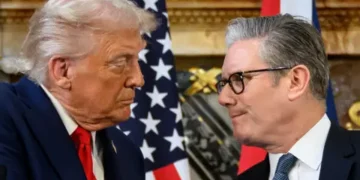






















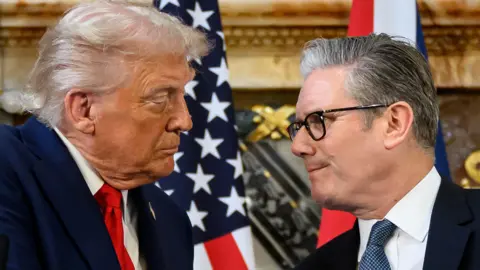
LONDON (MNN); British Prime Minister Keir Starmer held a telephone conversation with United States President Donald Trump on Sunday to discuss escalating tensions in the Middle East and military cooperation between the two long-standing allies.
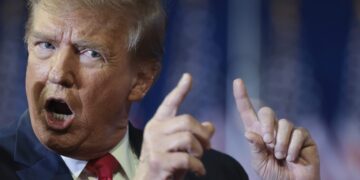
The call came less than a day after President Trump publicly criticised the British leader over what he described as insufficient support for the United States’ military campaign against Iran. The remarks had raised concerns about growing friction between Washington and London at a time of heightened regional instability.
According to a statement issued by Downing Street, the leaders discussed the latest developments in the Middle East and the ongoing cooperation between the United Kingdom and the United States through the use of Royal Air Force bases.
A spokesperson for the British prime minister said the conversation focused on “the latest situation in the Middle East and the military cooperation between the UK and US through the use of RAF bases in support of the collective self-defence of partners in the region.”
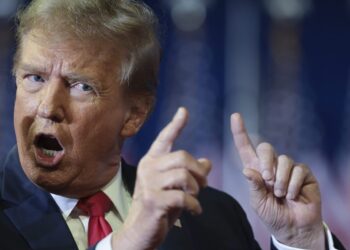
However, the official statement did not directly address Trump’s latest criticism posted on his social media platform Truth Social. Responding to reports that Britain might deploy an aircraft carrier to the region, Trump wrote: “We don’t need people that join wars after we’ve already won.”
Despite the tensions, the two leaders sought to maintain diplomatic engagement. During the call, Starmer also expressed condolences to the American president and the people of the United States following the deaths of six US soldiers in the region.
“The Prime Minister shared his heartfelt condolences with President Trump and the American people,” the Downing Street spokesperson said, adding that both leaders expressed their willingness to speak again soon.
The conversation appeared to be an attempt by Starmer to ease tensions that had emerged after a series of critical remarks by Trump. On Saturday, the US president had told his British counterpart that American forces did not require Britain’s assistance in the conflict, even though US military operations linked to Iran have continued to make use of British airbases.
The issue has also sparked debate within Britain’s ruling Labour Party. Former prime minister Tony Blair reportedly stirred controversy after telling a private gathering that the United Kingdom should have supported the United States from the outset of the conflict.
Blair suggested that Britain should have allowed the Trump administration to use British airbases for strikes against Iranian targets from the beginning of the military campaign.
“If they are your ally and they are an indispensable cornerstone for your security, you had better show up when they want you to,” Blair said, according to reports.
His remarks triggered criticism from several senior figures within the Labour Party. Britain’s Home Secretary Yvette Cooper rejected Blair’s comments and stressed that Britain must learn from past foreign policy mistakes, particularly those related to the Iraq war.
Speaking during an interview on Sky News, Cooper said she disagreed with Blair’s position and emphasised that the government must act in the best interests of British citizens.
“I don’t think either of those positions is in the UK’s national interest, and it is the responsibility of the prime minister to act in the UK’s national interest,” she said.
When asked whether Blair’s stance suggested Britain should blindly follow US policy, Cooper responded that the real lesson from previous conflicts was the importance of careful decision-making.
Meanwhile, military developments continued as part of the broader confrontation with Iran. The British Ministry of Defence confirmed that four US B-1 Lancer bombers had landed at a Royal Air Force base in Britain to conduct what officials described as “specific defensive operations.”
The aircraft arrived at RAF Fairford in Gloucestershire, with one bomber landing on Friday evening and three more arriving on Saturday morning.
According to defence officials, the deployment was intended to support operations aimed at preventing Iran from launching missile attacks in the Middle East.
The aircraft were deployed after Prime Minister Starmer authorised the United States to use British bases for defensive actions targeting Iranian missile sites.
The move comes as Washington has warned that military strikes against Iran could intensify significantly in the coming days, raising fears of a wider regional conflict.
At the same time, Starmer’s government is facing growing political pressure at home over a separate but related issue: Britain’s historical role in Palestine during the period of the British Mandate between 1917 and 1948.
Nearly 20 lawmakers from the Labour Party have called on the prime minister to issue a formal apology and consider reparations for Palestinians, arguing that Britain bears historical responsibility for policies that contributed to conflict in the region.
In an open letter organised by the campaign group Britain Owes Palestine, the lawmakers urged the government to acknowledge what they described as “war crimes” committed during Britain’s administration of Palestine.
The letter argued that Britain effectively “gave away Palestine, a land we had no right to give,” when it withdrew from the territory in 1948 following a United Nations-backed partition plan.
Britain’s withdrawal led to the creation of the state of Israel and the outbreak of the first Arab-Israeli war, events that remain central to the long-running Israeli-Palestinian conflict.
Campaigners claim that British policies during the mandate period contributed to violence and displacement, and they argue that acknowledging this history through an official apology would be an important symbolic step.
“An apology would not solve the conflict but would represent an initial step toward Britain confronting its own past,” the letter stated.
The document, reported by The Telegraph newspaper, was signed by 18 Labour members of parliament and one member of the House of Lords.
Among the signatories were prominent figures from the party’s left wing, including John McDonnell and Richard Burgon, who previously served in senior roles in the party under former leader Jeremy Corbyn.
The campaign group Britain Owes Palestine, launched in 2025, is advocating for the British government to acknowledge what it calls a “century of oppression” linked to British policies in the region.
The group has already submitted a 400-page legal petition to the government, arguing that Britain violated international law during its administration of Palestine.
If the government fails to respond to the petition, campaigners have warned they may seek legal action, including a judicial review in the High Court.
The controversy comes months after the British government formally recognised a Palestinian state in September as part of an effort to increase diplomatic pressure on Israel to agree to a ceasefire in Gaza.
A ceasefire was reached the following month, although the decision to recognise Palestinian statehood drew criticism from political opponents.
Britain’s Conservative Party argued that the move risked emboldening the militant group Hamas, while US Secretary of State Marco Rubio said the recognition would have little practical impact on achieving a two-state solution.
Analysts say the developments highlight the complex diplomatic challenges facing Starmer, who must balance relations with key allies, internal party divisions, and historical debates over Britain’s role in shaping modern Middle Eastern politics.