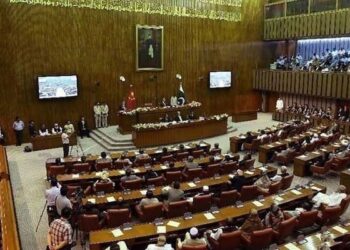

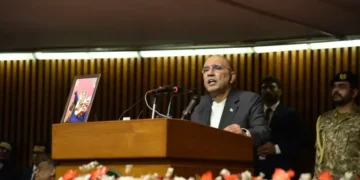






















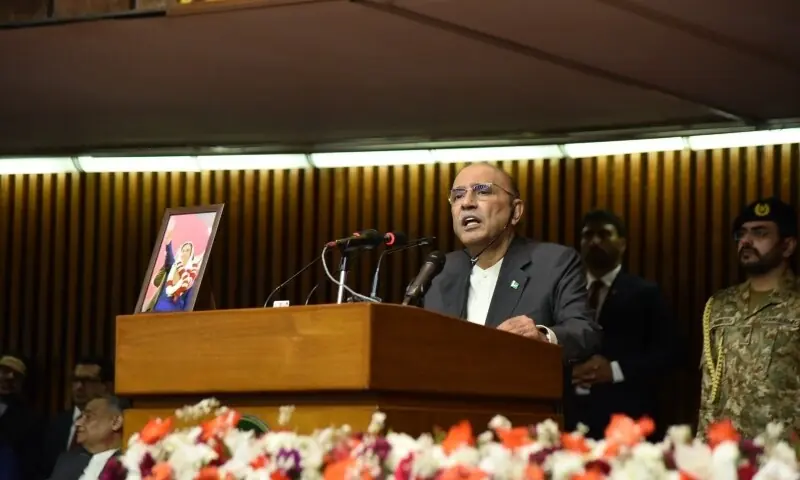
ISLAMABAD (MNN); President Asif Ali Zardari on Monday delivered his ninth address to a joint sitting of Parliament, pledging that Pakistan would not permit any domestic or foreign entity to use neighbouring territory to undermine its peace and stability. His speech, marking the beginning of the new parliamentary year, unfolded amid loud protests and sloganeering by opposition members.
Opposition lawmakers repeatedly chanted slogans including “Go, Zardari, go” and “Free Imran Khan,” disrupting the proceedings. At one stage, members of the opposition moved in front of the Speaker’s dais and continued their protest as the president pressed on with his address.
Opening his speech, President Zardari described it as a singular privilege to address the joint sitting for the ninth time. He said each presidential address symbolised the continuity of Pakistan’s democratic system and underscored the responsibility borne by elected representatives.
Reflecting on the country’s constitutional journey, he stated that the strength of the republic lay in adherence to the Constitution. He paid tribute to Quaid-i-Azam Mohammad Ali Jinnah, saying the founder of the nation had envisioned a democratic state rooted in constitutional supremacy and the rule of law.
Recalling his previous tenure, President Zardari referred to the landmark 18th Constitutional Amendment, through which presidential powers were transferred back to Parliament in accordance with the spirit of the 1973 Constitution. He said the presidency today stood as a symbol of unity, serving as a bridge between federating units and a guardian of constitutional order.
Security and Cross-Border Tensions
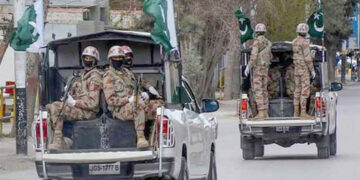
The president said the past ten months had severely tested the nation. When Pakistan’s sovereignty was challenged, he said, the country responded with strategic restraint and firm resolve. Referring to what he described as unprovoked attacks along both eastern and western borders, he commended the armed forces for responding with professionalism and discipline.
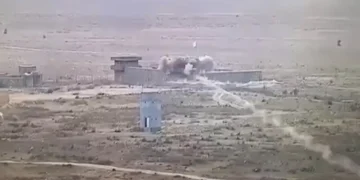
Speaking about Marka-i-Haq, he claimed Pakistan had turned India’s aggression into a strategic victory. On the western front, he said security forces acted decisively on the night of February 26 following a series of attacks attributed to the Taliban regime in Afghanistan.
He thanked the armed forces and law enforcement agencies for their vigilance and sacrifices, saying their dedication ensured that citizens could live and work in safety. He emphasised that the sacrifices of martyrs could not be measured merely in numbers, as each loss represented a family’s ultimate sacrifice for national stability.
According to the president, the year 2025 marked a turning point defined by a resounding military success in Marka-i-Haq. He maintained that Pakistan’s political leadership and people had stood united during the crises.
Kashmir and Warning to India
Turning to the issue of Kashmir, President Zardari said lasting peace in South Asia would remain elusive until the people of occupied Kashmir achieved freedom. He noted statements by Indian leaders suggesting preparations for another conflict.
Describing himself as a lifelong advocate of peace, he cautioned against further warfare but warned that any aggressor should be prepared for a humiliating defeat. He urged India to move from confrontation to meaningful negotiations, calling dialogue the only viable path to regional security.
He reiterated that Pakistan was a responsible nuclear state aware of its obligations, but equally determined to defend itself when required. The country’s conduct, he said, reflected maturity, confidence and clarity of purpose.
Afghanistan and Counterterrorism
The president accused India of amplifying proxy operations through Afghanistan and claimed that the Afghan Taliban regime had witnessed Pakistan’s capabilities when pushed beyond its red line. He said Islamabad had exhausted diplomatic avenues before resorting to military measures against terrorist incursions from Afghan soil.
Citing Article 51 of the United Nations Charter, he asserted Pakistan’s right to self-defence. He stated that both India and Afghanistan had seen only a fraction of Pakistan’s capabilities.
Over the past three years, he said, intelligence-based operations had targeted Indian-sponsored militants. He stressed that counterterrorism was not solely a military campaign but a national effort backed by the entire population.
He specifically mentioned Tehreek-i-Taliban Pakistan and the Balochistan Liberation Army, stating that Pakistan would not allow its territory to be destabilised by groups operating from across the border.
Referring to a recent United Nations Security Council monitoring report, he said terrorist groups based in Afghanistan posed an extra-regional threat. Despite multiple diplomatic engagements, he claimed, the Afghan de facto authorities continued to provide safe havens to organisations including Al-Qaeda, TTP and BLA, contrary to commitments made in Doha.
President Zardari urged the Afghan Taliban to dismantle terror networks, while reaffirming that Pakistan regarded the Afghan people as brothers and remained open to dialogue. He appealed for an end to Afghanistan being used as a battlefield for external ambitions.
Middle East Developments
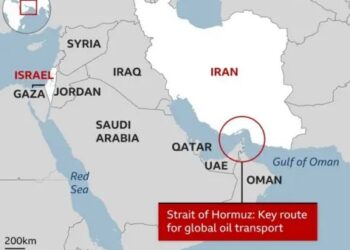
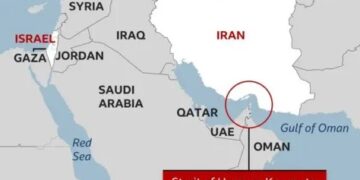
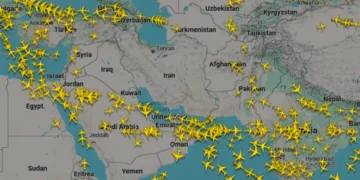
Addressing regional tensions in the Middle East, the president expressed deep concern over recent developments. He condemned the war being waged on Iran during ongoing negotiations and reiterated Pakistan’s support for Iran’s sovereignty and territorial integrity.
At the same time, he also criticised Iranian attacks on Gulf countries, urging maximum restraint and adherence to international law. Stability in the region, he said, was essential for rebuilding trust and preventing a deepening crisis.
Water Security and Indus Waters Treaty
President Zardari warned that water security had emerged as a strategic concern. He accused India of manipulating river flows and placing the Indus Waters Treaty in abeyance, terming such actions as hydro-terrorism and a weaponisation of vital water resources.
He said unilateral blockage of water violated international and humanitarian law and threatened Pakistan’s agricultural economy. The stability of transboundary water-sharing arrangements across the region, he warned, could be undermined if treaties were disregarded.
Pakistan, he declared, would defend its water rights with unity, resolve and legal clarity.
Federal Harmony and Balochistan
Reaffirming his constitutional duty to safeguard the federation, the president emphasised the importance of provincial autonomy and effective functioning of forums such as the Council of Common Interests.
He called for consultation in resolving issues related to natural resources, fiscal distribution, energy coordination and water management. He also expressed hope for a just and equitable National Finance Commission Award in the coming year.
Focusing on Balochistan, he acknowledged the province’s history of deprivation and said it deserved special attention. While insurgencies fuelled by foreign proxies would be dismantled, he stressed the need to address genuine socio-economic grievances and ensure that local communities benefited from mineral and maritime resources.
Economic Recovery and Reform
President Zardari linked economic stability with national security and commended the government for steering the country away from economic collapse in 2022. While macroeconomic indicators had stabilised, he said the next phase must prioritise inclusive growth, employment generation and relief for salaried classes, pensioners and small traders.
He underscored the importance of structural reforms, transparency in taxation and expenditure, and expansion of the tax base. Highlighting the role of technology and digital assets, he said Pakistan had reset policy frameworks to avoid technological isolation.
Energy costs, he noted, remained a major bottleneck for industrial revival. He advocated energy reforms and a shift toward clean energy, as well as climate-resilient agriculture and improved water management.
Concluding his address, President Zardari described security, economy and constitutional governance as interconnected pillars. He urged lawmakers to consolidate gains, protect sovereignty, eliminate terrorism, strengthen federal harmony and ensure that economic progress translated into relief for households.
Prime Minister Shehbaz Sharif, PPP Chairman Bilawal Bhutto-Zardari, MNA Aseefa Bhutto-Zardari, Punjab Chief Minister Maryam Nawaz, governors and chief ministers from across the provinces, and Opposition Leader Mehmood Khan Achakzai were present during the session.