




































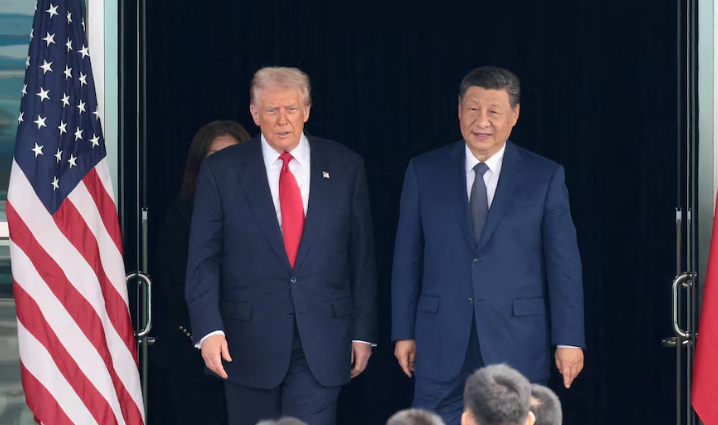
BEIJING, (Reuters): China sees an opening to turn President Donald Trump’s tariffs to its advantage by reshaping global trade in ways that would insulate its $19 trillion economy from U.S. pressure far into the future.
Beijing is exploiting the uncertainty created by Trump to try to stitch China’s vast manufacturing base into the world’s biggest economic blocs, including the European Union, Gulf States and a trans-Pacific trade pact, a Reuters examination found. The push involves accelerating efforts to clinch some 20 trade deals in total, many years in the making, despite widespread concerns about China’s overproduction, uneven market access and soft demoestic demand.
A Reuters review of 100 Chinese-language articles by state-backed trade scholars written since 2017 reveals a systematic push by China’s policy advisers to reverse-engineer U.S. trade policy and neutralize Washington’s containment strategy.
China is now putting that blueprint into action. The deal reached with Canada during Prime Minister Mark Carney’s January visit to Beijing — which slashes tariffs on Chinese electric vehicles — was the first of many aimed at breaking U.S. leverage, according to interviews with 10 people, including Chinese officials and trade diplomats.
“Don’t interrupt your opponent when he is making a mistake,” said one Chinese official of Trump’s disruptive trade agenda.
The review, drawn from over 2,000 trade-strategy papers endorsed by the Chinese Academy of Social Sciences (CASS) and Peking University, which advise top leaders, shows policy insiders broadly accept that painful structural change is a price worth paying for China’s long-term dominance of global commerce. The papers’ contents are reported here for the first time.
If successful, Beijing could upend more than a decade of U.S. trade policy by placing itself at the heart of a new, China-shaped multilateral order, two Western diplomats said.
“The Chinese have a golden opportunity now,” said Alicia Garcia Herrero, senior fellow at the Bruegel think tank.
China’s commerce ministry didn’t respond to a request for comment about Beijing’s strategy.
Asked about China’s approach, a U.S. official told Reuters it was no surprise that countries with large trade surpluses sought to maintain globalization.
“President Trump is fixing the problems globalization caused for the United States while other countries are trying to double down on globalization as free market access to the United States goes away,” the official said.
BUILDING BLOCS
The shift in China’s tone reflects its calculations. A year ago, Beijing was invoking Mao Zedong and its ability to fend off the West in the Korean War with martial propaganda.
Now, as China prepares to welcome Trump in April, its diplomats are touring the world urging trading partners to join it in defending multilateralism and open trade.
In January, China dispatched its top diplomat to tiny Lesotho – which Trump initially hit with a 50% tariff – to pledge development cooperation. On Saturday, state media said China would implement zero tariffs on imports from 53 African countries. Meanwhile, China is pitching AI-powered customs systems to neighbors and working to retool digital infrastructure that underpin commerce.