


























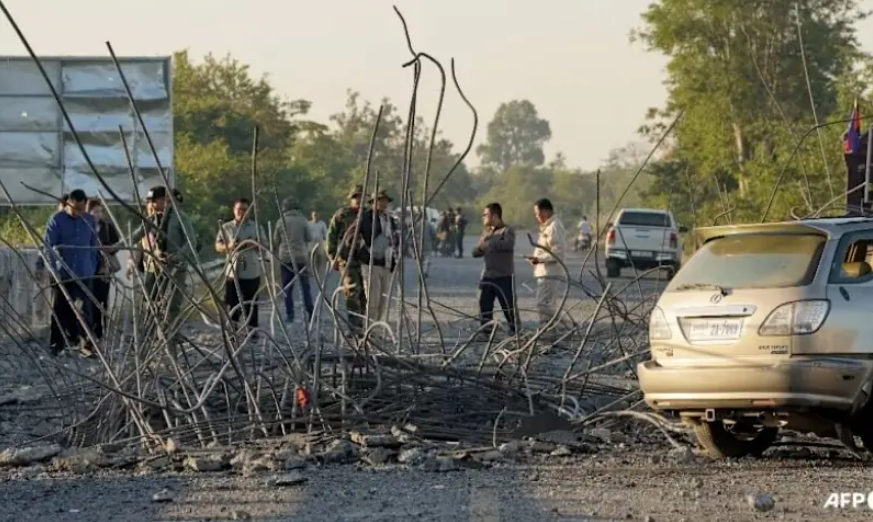
Thailand’s military said on Tuesday that Cambodian forces had described a new cross-border incident as accidental, after Bangkok accused them of breaching a 10-day-old ceasefire in an attack that injured a Thai soldier.
The long-running dispute between the two Southeast Asian neighbours flared into repeated military confrontations last year, with clashes in December leaving dozens dead and forcing about one million people on both sides of the border to flee their homes.
A ceasefire agreement reached on December 27 brought an end to three weeks of fighting.
“Cambodia has violated the ceasefire” early Tuesday, the Thai army said in a statement, alleging that Cambodian troops fired mortar shells into Thailand’s Ubon Ratchathani province.
The army added that one soldier was struck by shrapnel and was being evacuated for medical care.
In a follow-up statement, the Thai military said Cambodian officials had contacted a Thai unit and insisted “there was no intention to fire into Thai territory”, saying “the incident was caused by an operational error by Cambodian personnel”.
“The Thai military in the area warned Cambodian forces to exercise caution and stressed that if a similar incident were to occur again, Thailand may need to take retaliatory action,” the statement said.
Cambodia’s defence ministry spokeswoman, Maly Socheata, declined to comment on the alleged incident.
Prime Minister Anutin Charnvirakul said Thailand had filed a formal complaint with Phnom Penh, “stating that the truce was violated”.
“At the military-to-military level, we have been told the incident was an accident, but we are seeking clarification on how responsibility will be taken,” Anutin told reporters in Bangkok.
He added that Thailand had the “capability to respond” to Cambodia, which possesses far less military firepower than its neighbour.
Anutin also said provincial governors had been instructed to “make preparations, though no evacuation of residents has been ordered at this stage”.
Since the ceasefire was agreed last month, hundreds of thousands of civilians displaced by the December clashes on both sides of the border have started returning home.
‘Goodwill’
The prolonged conflict between Thailand and Cambodia originates from disagreements over the colonial-era demarcation of their 800-kilometre (500-mile) shared border, an area containing disputed land and ancient temple sites claimed by both countries.
As part of the December agreement, both sides pledged to halt hostilities, freeze troop movements and cooperate on clearing landmines along the frontier.
On December 31, Thailand released 18 Cambodian soldiers who had been detained since July, when border fighting earlier that month killed dozens.
Thailand’s foreign ministry described the move as “a demonstration of goodwill and confidence-building”.
Phnom Penh said last week it remained “hopeful” the release would “significantly contribute to building mutual trust”.
The United States, China and Malaysia had helped broker a ceasefire in July, but the agreement quickly collapsed.
In October, US President Donald Trump travelled to Malaysia to attend the signing of a renewed declaration, highlighting new trade deals after both sides agreed to extend the truce.
Thailand later suspended the agreement the following month, after its soldiers were injured by landmines during border patrols.
Disputed border
On Saturday, a week after the December ceasefire came into force, Cambodia urged Thailand to withdraw troops from several contested border areas that Phnom Penh says belong to Cambodia.
Thailand’s military rejected accusations that it had seized Cambodian land, insisting its troops were stationed in territory long recognised as Thai.
Although the two countries agreed to halt fighting late last month, the issue of border demarcation remains unresolved.
Cambodia’s defence ministry said Tuesday that it had proposed holding a bilateral border committee meeting with Thai officials later this month in Siem Reap province.
Thailand has previously said discussions on border surveying and demarcation may have to wait until after the formation of a new government, following elections scheduled for February 8.