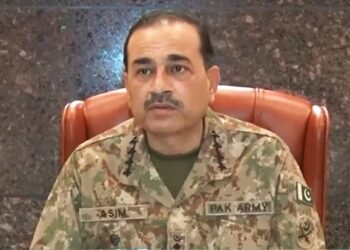































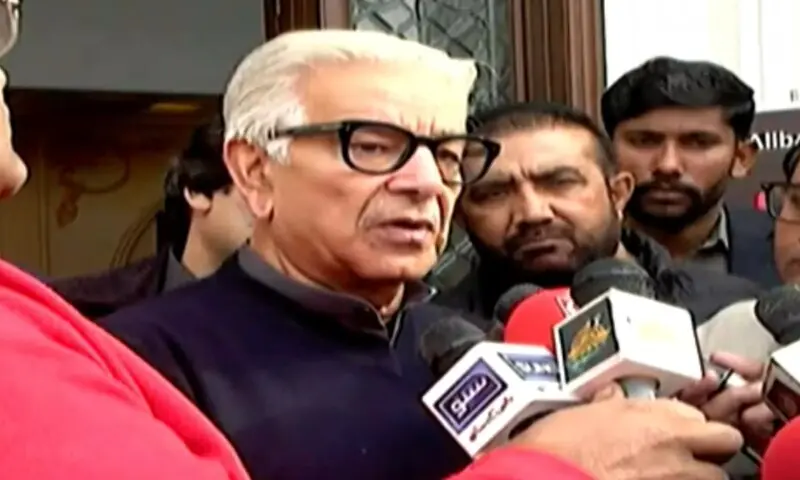
SIALKOT (MNN); Defence Minister Khawaja Asif on Saturday strongly criticised the PTI for its response to the ISPR director general’s recent press conference, in which Lt Gen Ahmed Sharif Chaudhry launched a harsh verbal attack on Imran Khan without naming him directly.
During Friday’s briefing, Lt Gen Chaudhry had described the former prime minister as “mentally ill”, “a narcissist”, and “a security risk”, adding that it was the government’s responsibility to decide how to deal with him. He also accused Imran and PTI of promoting a narrative aimed at weakening the armed forces and destabilising the state.
PTI Chairman Barrister Gohar Ali, responding to the remarks, had voiced disappointment, saying the party’s stance had never been anti-state.
Speaking to reporters in Sialkot, Khawaja Asif recalled that Imran Khan himself had repeatedly used harsh and mocking language against political opponents in the past and said PTI had no grounds to object to the ISPR spokesperson’s criticism.
He reminded that Imran had previously performed theatrics, including wearing a dupatta to mock Mehmood Khan Achakzai, who is now politically aligned with him, and had also used derogatory language about women. Asif added that even after imprisonment, Imran continued using such language through statements issued on his social media platform.
Asif described the DG ISPR’s remarks as “restrained”, saying his own criticism would be much more blunt. He accused PTI of adopting a narrative that contradicted national interests and criticised the party for allegedly failing to acknowledge the sacrifices of soldiers fighting terrorism.
The defence minister said he had attended funerals of numerous martyrs but had never seen PTI representatives at such ceremonies. He urged the party to appreciate the sacrifices of the armed forces instead of appearing soft toward militants. He warned PTI that if it continued with such an approach, it would inevitably receive strong criticism.
Referring to interviews given by Imran’s sisters to Indian media, Asif accused PTI of “engaging with the enemy” and questioned how they could claim to be patriotic. He alleged that the party had no loyalty to Pakistan and sought power as its only objective.
Asif also pointed to the conflict with India in May, saying Pakistan’s neighbours had expressed solidarity over the martyrdom of soldiers, while PTI had done nothing to support the country during that time. He said that even during conflict, the party criticised military leadership and questioned how PTI could now object to the DG ISPR’s words.
He warned PTI not to challenge Pakistan’s sovereignty and honour while pursuing politics or protests.
Responding to the ISPR chief’s statements the previous day, Barrister Gohar had said it was unfortunate when institutions and political leaders labeled each other as mentally unfit or as threats.
He reaffirmed that Pakistan and the army belonged to the people and rejected allegations that PTI promoted anti-state narratives. He said tensions between the party and institutions should not be created by “non-stakeholders”. Gohar said allowing meetings with Imran Khan and Bushra Bibi would help ease the situation, adding that the country could not afford further instability.
Meanwhile, Federal Information Minister Attaullah Tarar said that PTI members who claim they do not endorse Imran’s statements could still be part of a dialogue process. Speaking on a TV programme, he said that the Khyber Pakhtunkhwa chief minister would not be allowed to wait outside Adiala Jail and would be sent back from the checkpoint. He suggested that arrests of Imran Khan’s sisters could also not be ruled out.
Commenting on Azma Khan’s meeting with Imran, Tarar said it was arranged to ensure no political discussion took place and to avoid social media activity. He warned that political activity that endangered national security would not be permitted. Tarar added that dialogue with PTI would only be possible if the party withdrew statements deemed harmful to national security.
He further said that PML-N leader Nawaz Sharif had always maintained restraint in criticism, and even when he personally criticised Shahid Khaqan Abbasi, he later advised against speaking harshly or making baseless allegations.