








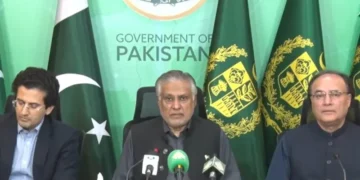


































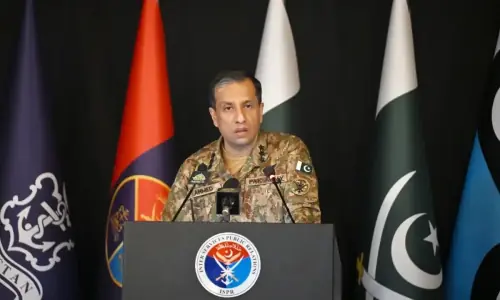
RAWALPINDI (MNN); Director General Inter-Services Public Relations (ISPR) Lt Gen Ahmed Sharif Chaudhry sharply criticised incarcerated PTI founder Imran Khan on Friday, accusing him of promoting an anti-army narrative that, according to him, has crossed the boundaries of politics and turned into a national security threat.
Opening his press conference in Rawalpindi, Lt Gen Chaudhry spoke of a growing national security challenge that the military felt compelled to address. Without naming Imran Khan directly, he said the threat stemmed from a delusional mindset of a person who considered his own wishes above the interests of the state.
He remarked that Imran Khan’s ego had reached a point where he believed the world could not function without him. The DG ISPR stressed that the narrative Imran was pushing was no longer political, but had now become an issue tied to national security.
He said the military’s media wing found it necessary to clarify matters, remove ambiguities and address how this narrative was being strengthened through cooperation with external elements. He reminded that Pakistan’s armed forces represent no ethnicity, language, sect or political group, and consist of people from every region who set aside personal identities when wearing the uniform.
Lt Gen Chaudhry warned that if the army or its leadership was targeted due to someone’s personal frustrations or ego, the institution would respond firmly. He urged political parties to keep their political battles away from the military and refrain from dragging the institution into politics.
He outlined ways in which Imran’s rhetoric was harming the forces, emphasising that no one would be allowed to create divides between the army and the public. He said constructive criticism was welcome, but instigating people against their own military was unacceptable. He questioned the purpose behind attempts to create space for foreign armies through attacks on Pakistan’s own forces.
He accused Imran of consistently promoting anti-state narratives, recalling past actions such as urging Pakistanis to stop sending remittances, writing to the IMF to block agreements, promoting civil disobedience by refusing to pay electricity bills, and allegedly encouraging followers to target army leadership. He questioned who would benefit from such actions, suggesting that such narratives aligned with agendas coming from Delhi.
The DG ISPR also showed video clips of Imran’s anti-army tweets and highlighted the role of anonymous social media accounts, allegedly run from abroad, in spreading such content. He noted that Indian and Afghan online platforms were amplifying Imran’s posts, aligning with their hostility towards the Pakistan Army.
He further said that Imran’s criticism of PTI members who attended an event at NDU implied that anyone linked to the military was being labelled a traitor. He added that the time had come to end political manipulation and false narratives.
Responding to questions, Lt Gen Chaudhry clarified that issues like banning PTI or imposing governor’s rule in KP were decisions for the state and government, not the army. He urged the PTI to focus on governance in Khyber Pakhtunkhwa rather than repeatedly targeting the military.
He also criticised PTI’s stance on terrorism and its calls for talks with militant groups, questioning whether national security could be outsourced or whether appeasement could ever be a security strategy.
The DG ISPR said the Pakistan Army would continue fulfilling its duty to protect the country, emphasising that no individual or political agenda could be allowed to supersede the state.
He also announced that the headquarters of the chief of defence forces (CDF) had formally begun functioning, calling it an important step toward ensuring joint operational capability across multiple modern domains of warfare. He said the CDF headquarters had been established on parliamentary directives and marked a significant development for Pakistan’s national security.