
























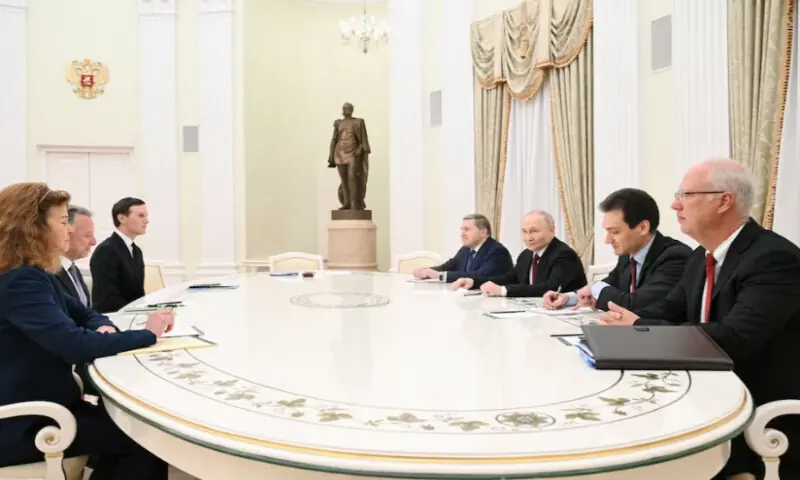
Web Desk (MNN); Russian President Vladimir Putin held a key meeting at the Kremlin on Tuesday with Donald Trump’s special envoy Steve Witkoff and the US president’s son-in-law Jared Kushner, as Washington attempts to find a breakthrough to end Europe’s deadliest conflict since World War Two.
The meeting came shortly after Putin warned that Europe would face a swift and decisive defeat if it attempted to go to war with Russia, dismissing recent European counter-proposals on Ukraine as totally unacceptable for Moscow.
Trump has repeatedly expressed a desire to end the conflict, but despite earlier engagements – including a summit with Putin in Alaska in August and meetings with Ukrainian President Volodymyr Zelenskiy – no agreement has yet emerged.
Tensions rose last week after the leak of a 28-point draft peace proposal from the United States, which alarmed Ukrainian and European leaders who said the plan conceded to several of Moscow’s major demands, including limiting Ukraine’s army, accepting Russian control of around one-fifth of Ukraine, and halting Kyiv’s NATO ambitions.
Following strong objections, European countries put forward their own proposal. Later talks in Geneva led Kyiv and Washington to announce that they had formed an updated and refined peace framework.
During Tuesday’s meeting, Putin welcomed the visiting delegation. Witkoff praised Moscow, describing it as a magnificent city, after touring Red Square with Kushner and Russian officials.
Accusing European governments of trying to obstruct progress, Putin said they were aligned with war rather than peace and were deliberately proposing terms that Russia could never accept. He also issued a stark warning, saying that if Europe started a war against Russia, it would end so quickly that no negotiating partner would remain.
Putin further threatened to cut off Ukraine’s access to the sea in response to Kyiv’s drone strikes on Russia’s so-called shadow fleet in the Black Sea. Ukraine’s foreign minister Andrii Sybiha said Putin’s remarks showed Moscow was not serious about ending the war.
Russian forces currently control more than 19 percent of Ukrainian territory, advancing in 2025 at their fastest rate since early 2022, according to pro-Ukrainian mapping sources. Despite this, Russia has been unable to subdue Ukraine, which continues to receive military and diplomatic backing from the United States and Europe.
Speaking in Dublin, President Zelenskiy said the outcome of the Moscow talks would be crucial. He stressed that there must be transparency and no back-door negotiations affecting Ukraine’s sovereignty.
Putin said current discussions were not about a formal peace agreement but a collection of proposals that might eventually form a foundation for future negotiations. He maintained that Russia was ready for peace talks but warned that if Ukraine refused, Russian forces would push further into Ukrainian territory.
A Russian official described the Trump administration’s involvement as the best opportunity for peace since early 2022, when negotiations broke down shortly after Russia’s invasion.
The conflict traces its roots back to 2014, when Ukraine’s pro-Russian president was ousted, followed by Russia’s annexation of Crimea and separatist uprisings in eastern Ukraine.
Russia recently claimed the capture of Pokrovsk in eastern Ukraine, calling it a major victory. However, Ukrainian forces told Reuters they were still defending parts of the city and had launched counterattacks.
US estimates suggest more than 1.2 million soldiers have been killed or wounded since the start of the war. Both sides have suffered heavy losses, though neither discloses official casualty numbers.
As Washington’s leaked peace proposal circulates, European governments worry that a deal favourable to Moscow could pave the way for renewed US-Russia economic cooperation and even reinstate Russia’s place in the G8.
Russia’s core demands include a permanent ban on Ukraine joining NATO, limits on the Ukrainian military, full control of Donbas, recognition of Russia’s hold over Crimea, Donbas, Zaporizhzhia and Kherson, and protections for Russian speakers in Ukraine.
Ukraine says accepting these conditions would amount to surrender and leave the country vulnerable to further Russian advances. The US has floated a 10-year security guarantee for Kyiv, but Kyiv and Europe insist the war must not reward Russia’s actions.