














































ISLAMABAD (MNN); The federal government on Monday emphasised that imposing governor’s rule in a province is a constitutional provision, as discussions intensify regarding the situation in Khyber Pakhtunkhwa. The statement comes hours after KP Chief Minister Sohail Afridi openly challenged Islamabad, daring the Centre to enforce the measure.
According to official sources, the federal government is actively reviewing the option of governor’s rule in KP, citing governance lapses and deteriorating security as the basis for the possible intervention.
Law Minister Azam Nazeer Tarar, addressing the National Assembly, said the Constitution itself grants the authority to impose governor’s rule. “It is not martial law — it is a constitutional framework created by the founders. If the situation demands it, the option is fully legitimate,” he asserted.
Information Minister Attaullah Tarar echoed the stance, stating that when administrative performance weakens, such constitutional mechanisms naturally come under debate. “Let us see how the situation unfolds,” he added.
Meanwhile, Minister of State for Interior Talal Chaudhary urged CM Afridi to avoid confrontation and to fulfil his executive responsibilities instead of indulging in “political point scoring.” He said the Centre had kept the provincial leadership informed on security developments and expected cooperation in return.
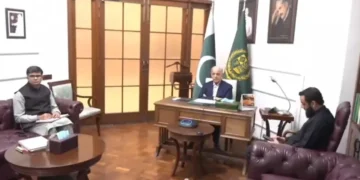
Last week, KP Governor Faisal Karim Kundi met Prime Minister Shehbaz Sharif to review provincial issues, including governor’s rule. The meeting was also attended by Federal Ministers Engineer Amir Muqam and Rana Mubashir Iqbal. According to reports, the deadlock between the KP government and the Federation — particularly over relations with state institutions — is a key factor behind the move being considered.
Responding to speculation, CM Afridi threw down the gauntlet, saying his government did not fear governor’s rule. “If they have the courage, let them impose it,” he remarked in Peshawar.
He criticised the Centre for depriving KP of its rightful financial share, claiming over Rs3,000 billion were due to the province. “Imagine what we could achieve if this amount were released. Instead, we are being treated unfairly,” he said.
Afridi also referenced the recent IMF report highlighting institutional corruption and blamed the federal government for the crisis.
In Parliament, PTI MNA Asad Qaiser criticised Islamabad’s approach, calling the governor’s rule debate “undemocratic” and warning of political backlash. PTI Chairman Barrister Ali Gohar, however, dismissed the possibility entirely, saying conditions do not justify such a move. He insisted that governance must continue under the Constitution and urged against fuelling rumours.
Speaking on the denial of family meetings with Imran Khan, Gohar noted that nearly a month has passed without access. “He is the people’s leader with representation in Parliament. This isolation is wrong — meetings must resume so matters can move forward.”