















































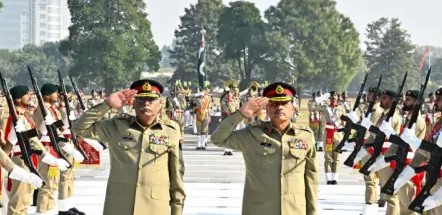
ISLAMABAD (MNN); Pakistan’s defence command system underwent its most significant overhaul to date as the office of the chairman Joint Chiefs of Staff Committee (CJCSC) was dissolved after nearly 50 years, following the enforcement of the 27th Constitutional Amendment at midnight on Thursday.
The position was abolished upon the retirement of General Sahir Shamshad Mirza, the last CJCSC, while the government has yet to formally notify the appointment of the country’s first chief of defence forces (CDF) under the restructured framework.
The amendment to Article 243, approved by parliament on November 13 and signed into effect by President Asif Ali Zardari, merges operational and strategic authority under a single office, where the chief of defence forces will also serve as chief of army staff.
Field Marshal Asim Munir is expected to take charge as CDF-cum-COAS, beginning a new five-year term with the possibility of another extension.
Under the new arrangement, joint operational planning, inter-service coordination and multi-domain warfare strategy will be centralised under the CDS command.
The reform also introduces a new four-star position – Commander National Strategic Command (CNSC) – who will oversee nuclear and strategic operations.
The transition marks the end of an institution originally established in 1976 to ensure balance between the three services.
However, critics argue that the CJCSC never achieved its intended functionality, and warn that the reform heavily concentrates power in one office, potentially weakening the roles of the navy and air force.
Supporters maintain that modern warfare demands centralised integration, streamlined decision-making and elimination of overlap.
Despite the transition, relevant adjustments to the National Command Authority Act are still pending, and the future structure of the Joint Services Headquarters remains unclear.
In his farewell message, Gen Mirza extended best wishes to the three services and expressed hope that the reorganised structure would meet future security challenges with unity and commitment.